

Zhangye · City culture
An oasis of buildings, beliefs and colour.
Zhangye belongs to the Hexi Corridor, where oasis settlements connected places of trade and religious exchange. The Great Buddha Temple preserves a substantial Western Xia Buddhist legacy, while the Wooden Pagoda gives the city’s religious architecture a different, vertical form. Their halls, sculpture and stacked eaves invite attention to how belief becomes a built space.
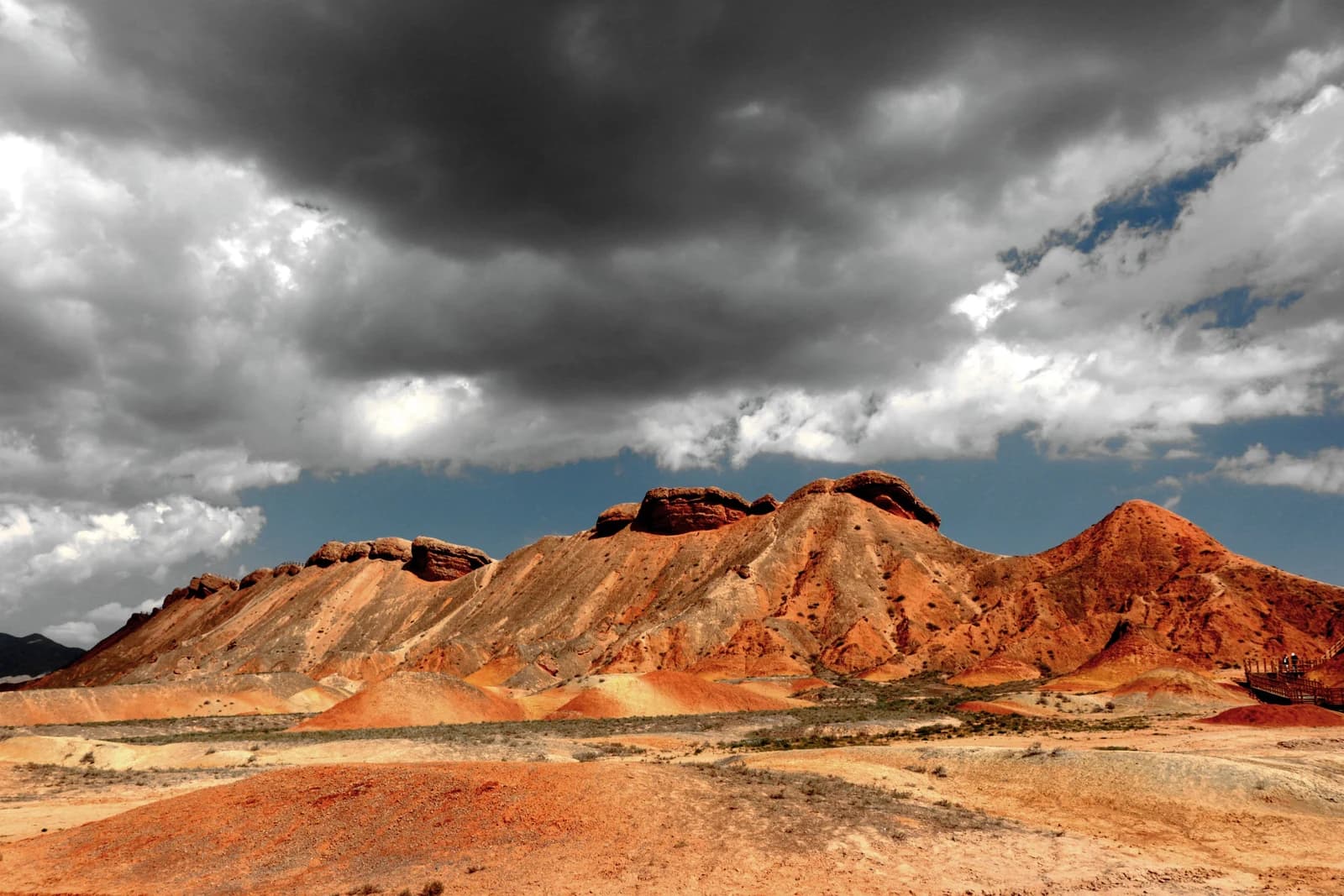
Beyond the city, the Colourful Hills introduce a much longer history. Tilted bands and eroded slopes expose the structure of the landscape. Reading Zhangye at these two scales connects the work of builders and artists with the geological processes that shaped the surrounding country.
Rock layers and city landmarks.
The Danxia landscape lies outside the urban centre. The Great Buddha Temple and Wooden Pagoda offer complementary views of Zhangye’s architectural heritage within the city.
Inside this city guide.
Choose a landscape or a city landmark, then look for the details that give it its character. Further chapters explore more neighbourhoods, cultural places and landscapes through collected travel notebooks.
Zhangye · Layered hills & geological time
Colourful Danxia
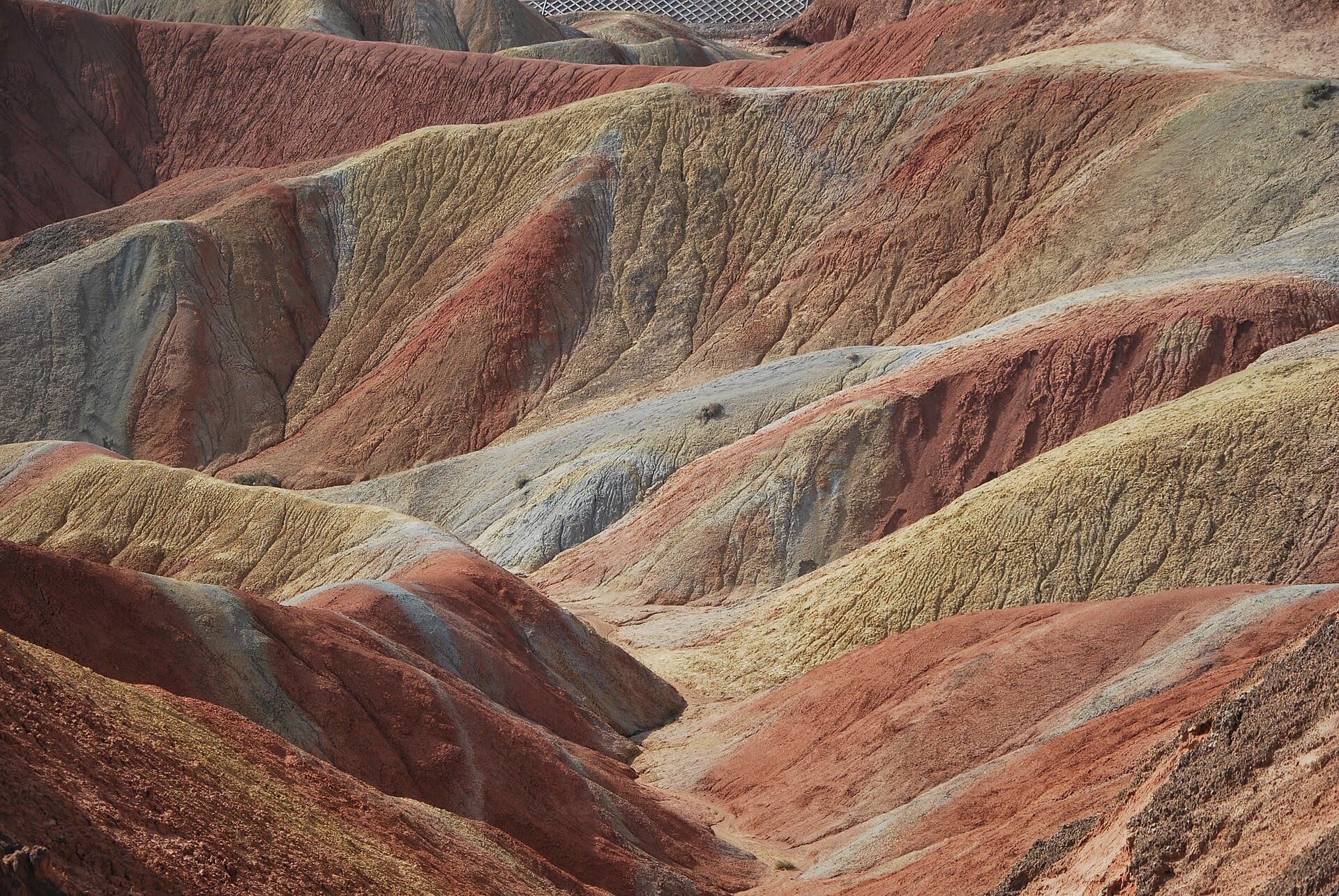
Look beyond the bands of colour: the tilted layers and changing shapes explain how this landscape was made.
Caption & source
Follow a layer across the hills
Zhangye’s Colourful Hills form part of the Zhangye UNESCO Global Geopark. Their sloping bands reflect geological layers raised and tilted by tectonic movement, then exposed by erosion. The colourful hills and the more strongly sculpted Danxia formations belong to a varied geological landscape rather than one uniform type of scenery.
Start with a single band and follow it across a ridge. Notice where the slope interrupts it, where a gully cuts through it and how the repeated layers establish a rhythm. This makes the landscape easier to read than treating every hill as an isolated rainbow-shaped object.
Sources & photograph credits
Background and reading notes adapted from the sources below. Photographs are credited to their original authors.
- Zhangye UNESCO Global Geopark
UNESCO · Checked
Geopark identity, the Colourful Hills, tectonic uplift, erosion and the distinction between colourful hills and other Danxia formations. Observation suggestions are editorial.
- Zhangye Colorful Hills
UNESCO World Heritage Centre — China’s Tentative List submission · Checked
Banded rock strata and the physical structure of the Colourful Hills. This is a Tentative List submission, distinct from the geopark designation.
Zhangye · Western Xia heritage & Buddhist sculpture
Great Buddha Temple
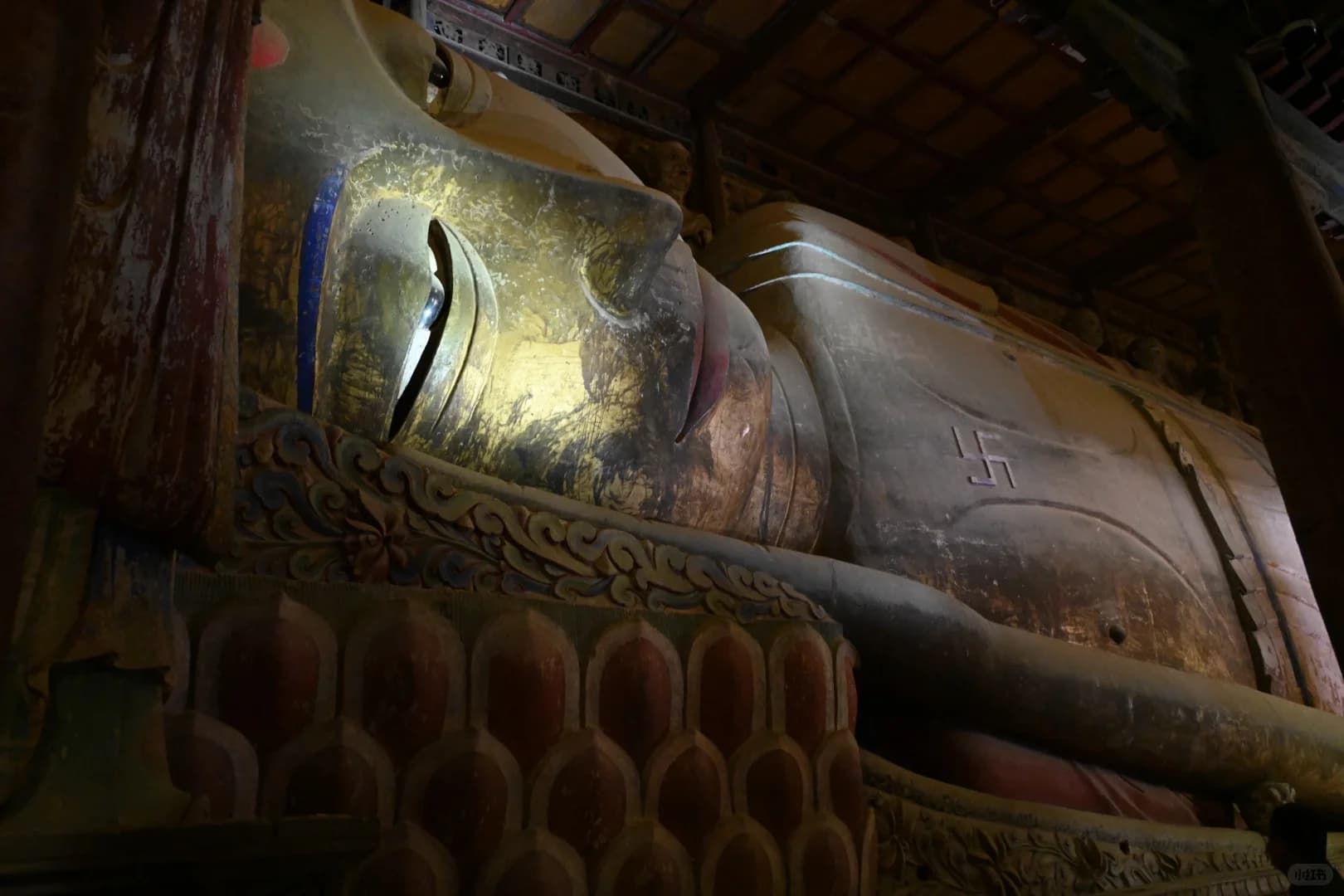
A monumental reclining Buddha anchors a temple complex whose buildings and collections preserve several layers of Buddhist history.
Caption & source
Read the hall and the sculpture together
The Great Buddha Temple is closely associated with the Western Xia period. Its central hall contains a large reclining Buddha made with a wooden framework and modelled clay. The figure’s horizontal shape and the hall that shelters it form a single architectural experience: the building sets the scale for the sculpture, and the sculpture gives the room its focus.
The wider complex includes buildings and objects from later periods, including Buddhist scriptures and a Ming-period pagoda. Notice how the large hall, smaller details and surviving texts tell different parts of the same religious story. The temple rewards looking at its material and craftsmanship as well as the size of the Buddha.
Sources & photograph credits
Background and reading notes adapted from the sources below. Photographs are credited to their original authors.
- 张掖大佛寺景区
Zhangye Municipal Culture, Radio, Television and Tourism Bureau · Checked
Western Xia temple and hall, wooden-framed clay reclining Buddha, scriptures and the later architectural layers of the complex. Suggested viewing connections are editorial.
- 张掖大佛寺:古刹承文脉 瑰宝焕新辉
Zhangye Municipal People’s Government — Ganzhou Media · Checked
The Western Xia foundation and the temple’s surviving halls, scriptures and later architectural layers.
Zhangye · Rebuilt heritage & tiered eaves
Wooden Pagoda
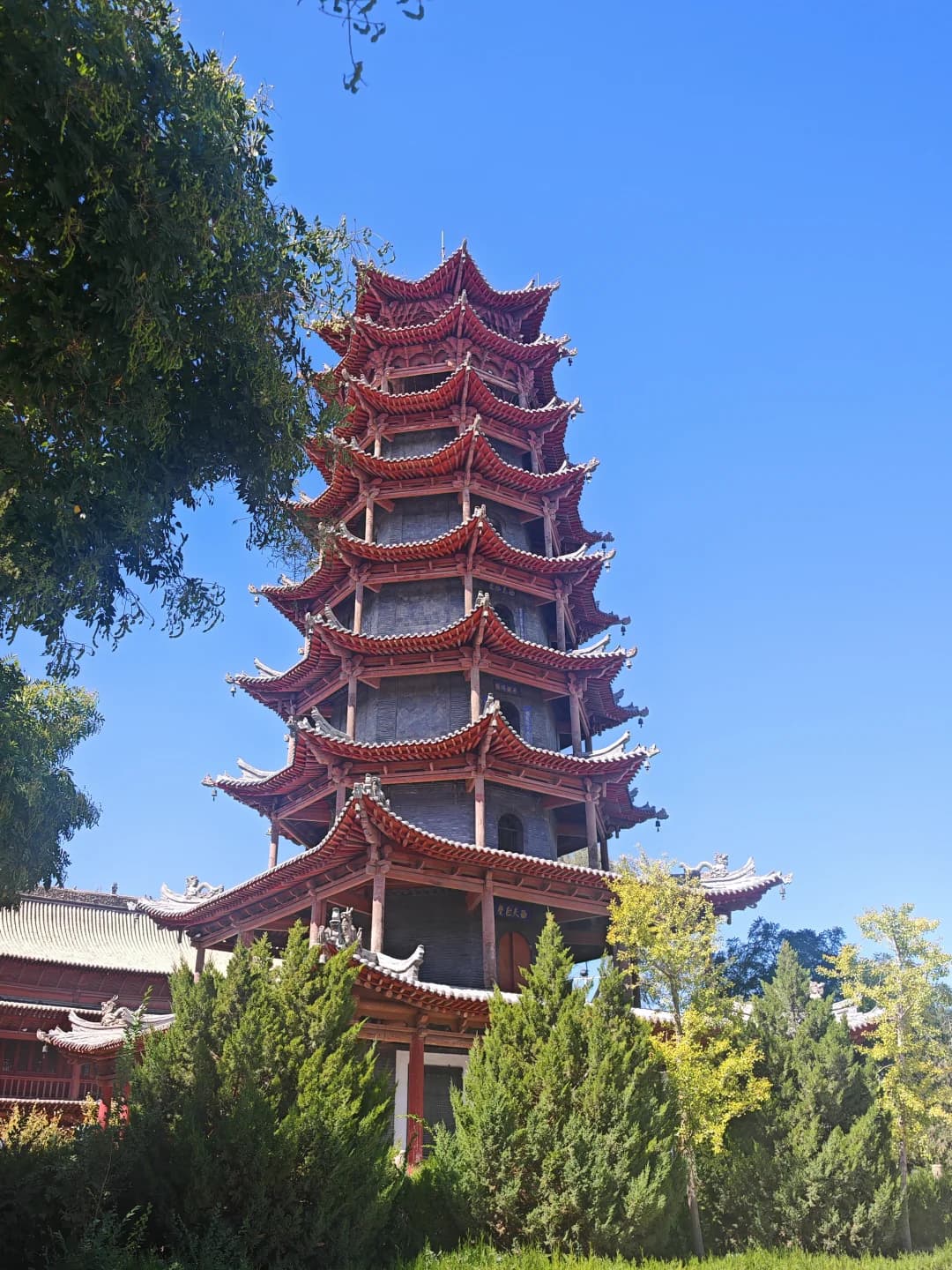
Nine tiers of projecting eaves make this pagoda a recognisable landmark in Zhangye’s urban heritage.
Caption & source
A long history, a later rebuilding
The Wooden Pagoda is associated with Wanshou Temple, a religious site rebuilt in several periods. The tower standing today was reconstructed in 1926. Despite its familiar English name, its fabric combines masonry with timber elements; it should be understood through both its construction and its history of renewal.
Look upward from the lower walls to the repeated wooden eaves. Their changing proportions and bracketed upper levels give the tower its outline. This vertical rhythm offers a useful comparison with the broad horizontal form of the Great Buddha Temple’s hall, showing how different structures create different ways of seeing religious architecture.
Sources & photograph credits
Background and reading notes adapted from the sources below. Photographs are credited to their original authors.
- 《张掖大词典》(初稿·文物):万寿寺木塔
Zhangye Municipal Local Chronicles Office · Checked
Wanshou Temple association, repeated rebuilding, 1926 reconstruction, nine tiers and the combination of masonry and timber. The comparison of building forms is editorial.
Zhangye · Cliff temples & mountain scenery
Mati Temple grottoes
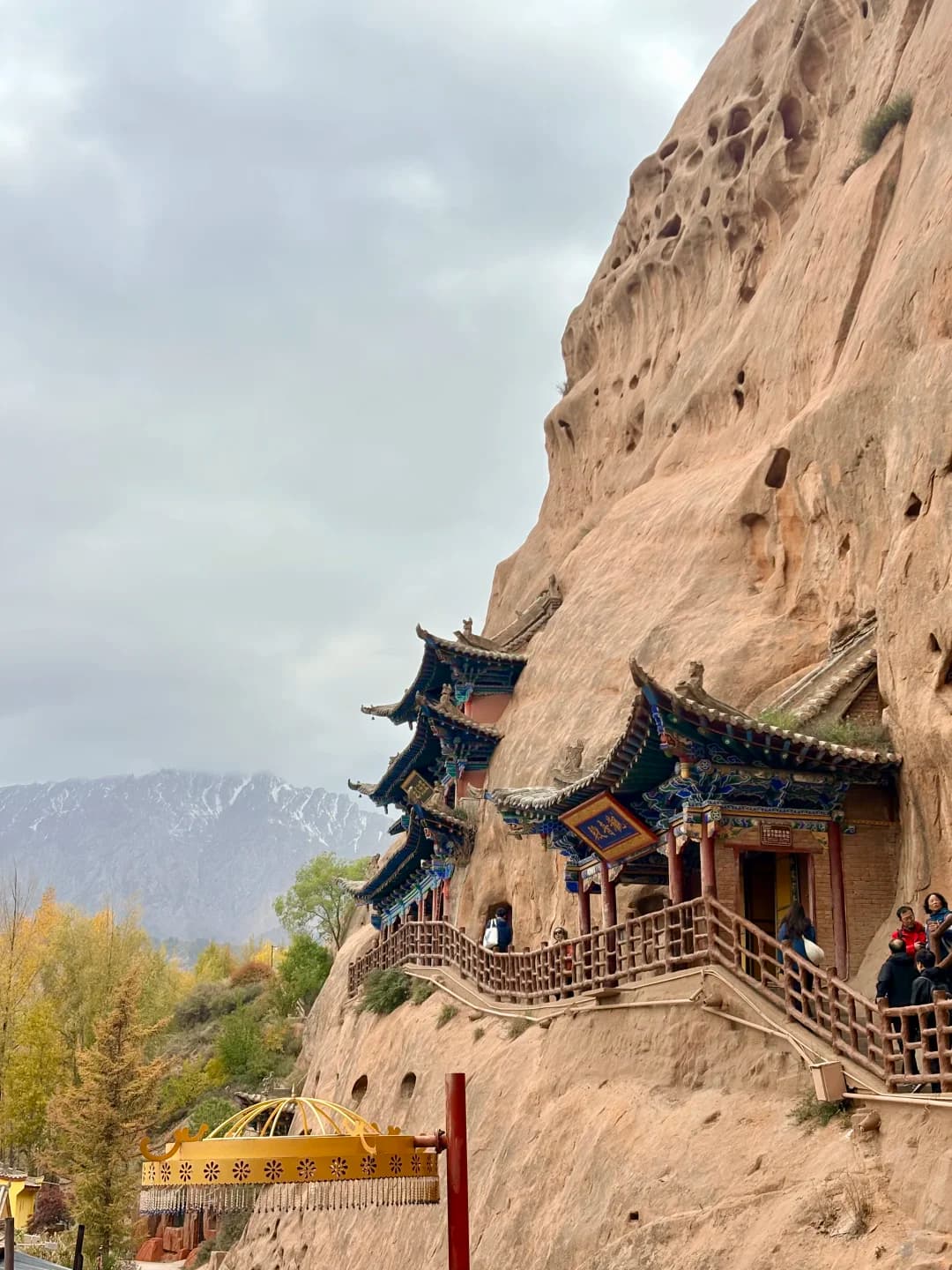
Painted wooden fronts emerge from weathered rock, with the Qilian foothills forming a broad backdrop.
Caption & source
A temple shaped by the cliff.
At Mati Temple in Sunan, Buddhist cave architecture is cut into the rock itself. The Thirty-Three Heavens group links caves vertically inside the cliff.
From outside, small roofed entrances and galleries give the bare rock a human scale. Their colour and timber detail reward a closer look.
Look beyond the cave entrances.
The collected notes also linger on the surrounding mountain scenery. Trees and open ground soften the transition between the cliff and the wider valley.
The interior passages involve steep, confined climbing. Looking at the facades and landscape is a different way to appreciate the setting; a visit need not revolve around reaching the highest cave.
Sources & photograph credits
Background and reading notes adapted from the sources below. Photographs are credited to their original authors.
- Mati Temple grottoes
Zhangye Municipal History Office · Checked
The cliff-cut Buddhist grottoes in Sunan and the connected caves of the Thirty-Three Heavens group.
- 张掖|马蹄寺-攀爬的欲望胜于游览
Xiaohongshu · 一萬(中女重组版) · Checked
Archived travel-note body and original photographs informed the descriptions of visible details. These observations are adapted, not a Matchstick field report.
- 张掖马蹄寺半日游|遇见红崖石窟与山间小鹿
Xiaohongshu · 安住 · Checked
Archived travel-note body and original photographs informed the descriptions of visible details. These observations are adapted, not a Matchstick field report.
Zhangye · Rock formations & canyon walks
Pingshan Lake Grand Canyon
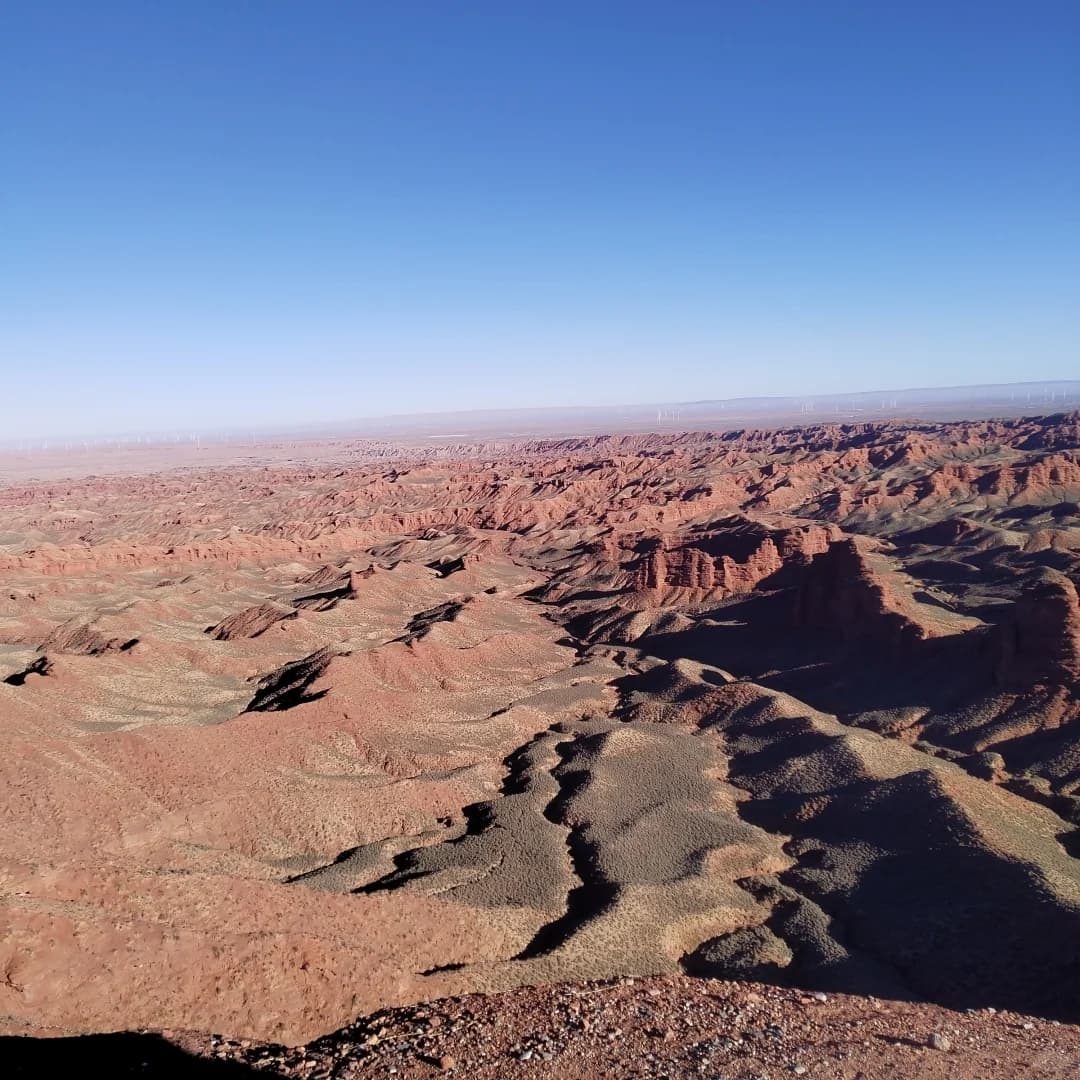
Rust-red towers and deeply cut gullies extend across an open, dry landscape outside Zhangye.
Caption & source
Read the canyon from above.
Pingshan Lake Grand Canyon is a landscape of red sandstone and conglomerate. Viewpoints reveal ridges, isolated pillars and channels cut through the plateau.
Light and shadow make the relief easier to read: broad sunlit tops sit above dark folds, while the horizon shows how far the formations continue.
A changing sense of scale.
The archived walking note describes the shift from wide rim views to narrow passages between rock walls. At ground level, textures and layers replace the distant panorama.
Some canyon paths involve sustained stairs and steep ladders. Choosing viewpoints or a longer descent changes both the physical effort and the way the landscape is experienced.
Sources & photograph credits
Background and reading notes adapted from the sources below. Photographs are credited to their original authors.
- Pingshan Lake Grand Canyon
Zhangye Municipal Culture and Tourism Bureau · Checked
The red sandstone and conglomerate canyon, with views from the rim and valley paths.
- 张掖“平山湖大峡谷”(一线天+灵芝谷)
Xiaohongshu · 下山贱拉风👺黑面菜 · Checked
Archived travel-note body and original photographs informed the descriptions of visible details. These observations are adapted, not a Matchstick field report.