


Chengdu · City culture
A city understood at a slower pace
Tea in Chengdu is a way of sharing public space. At a park teahouse, the table and chairs matter almost as much as the cup: people settle in, talk and watch the life around them. Sitting for a while can reveal more of this social rhythm than collecting another landmark.
The city also offers quieter ways to look closely. Wenshu Monastery brings religious practice and architectural detail into the urban fabric, while panda conservation opens a wider view of Sichuan’s forests. Together they connect everyday life with care for cultural and natural surroundings.
Tea, temples and panda conservation
Begin with the places that make the city’s pace visible, then read the panda chapters for the distinction between an animal encounter and the work of conservation.
Inside this city guide.
Choose a place below, or keep reading from park life to religious heritage and panda conservation. Further chapters explore more neighbourhoods, cultural places and landscapes through collected travel notebooks.
Chengdu · Park tea & public life
People's Park
A cup of tea and a seat beneath the trees offer a close view of Chengdu’s sociable public life.
Caption & source
Stay long enough to notice the rhythm
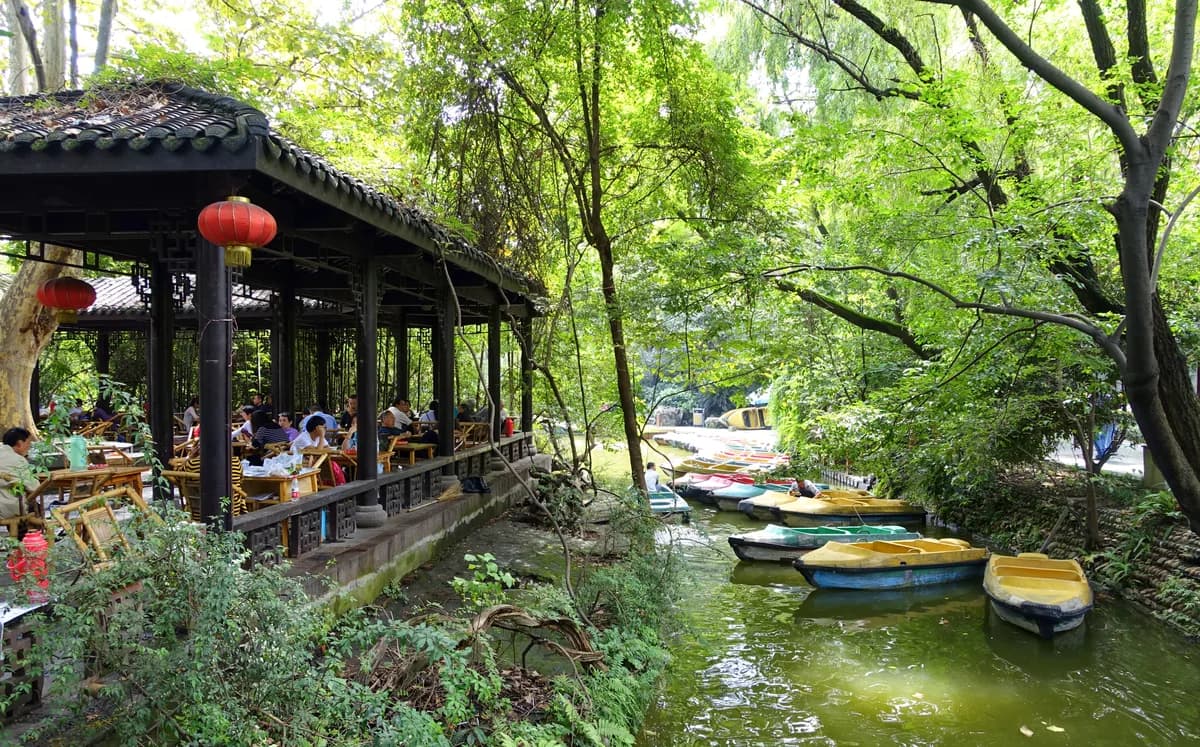
People’s Park is home to Heming Teahouse, one of Chengdu’s long-established places for tea. The appeal is the shared setting: an unhurried table, conversation and the movement of people through the park.
Take in the relationship between the tea tables and the green space around them. This is a useful place to understand tea as time spent together, rather than only as a drink to taste. A quiet pause makes room to notice that ordinary social life.
Sources & photograph credits
Background and reading notes adapted from the sources below. Photographs are credited to their original authors.
- Teahouse Leisure for Chengdu’s Autumn
GoChengdu · Checked
Identifies Heming Teahouse in People’s Park and the shared leisure of tea and conversation. The reading suggestions are editorial; no current service hours are reproduced.
Chengdu · Buddhist heritage & architecture
Wenshu Monastery
A Buddhist monastery in Qingyang where architecture, sculpture and religious life reward a quieter kind of attention.
Caption & source
Look at the building and its purpose
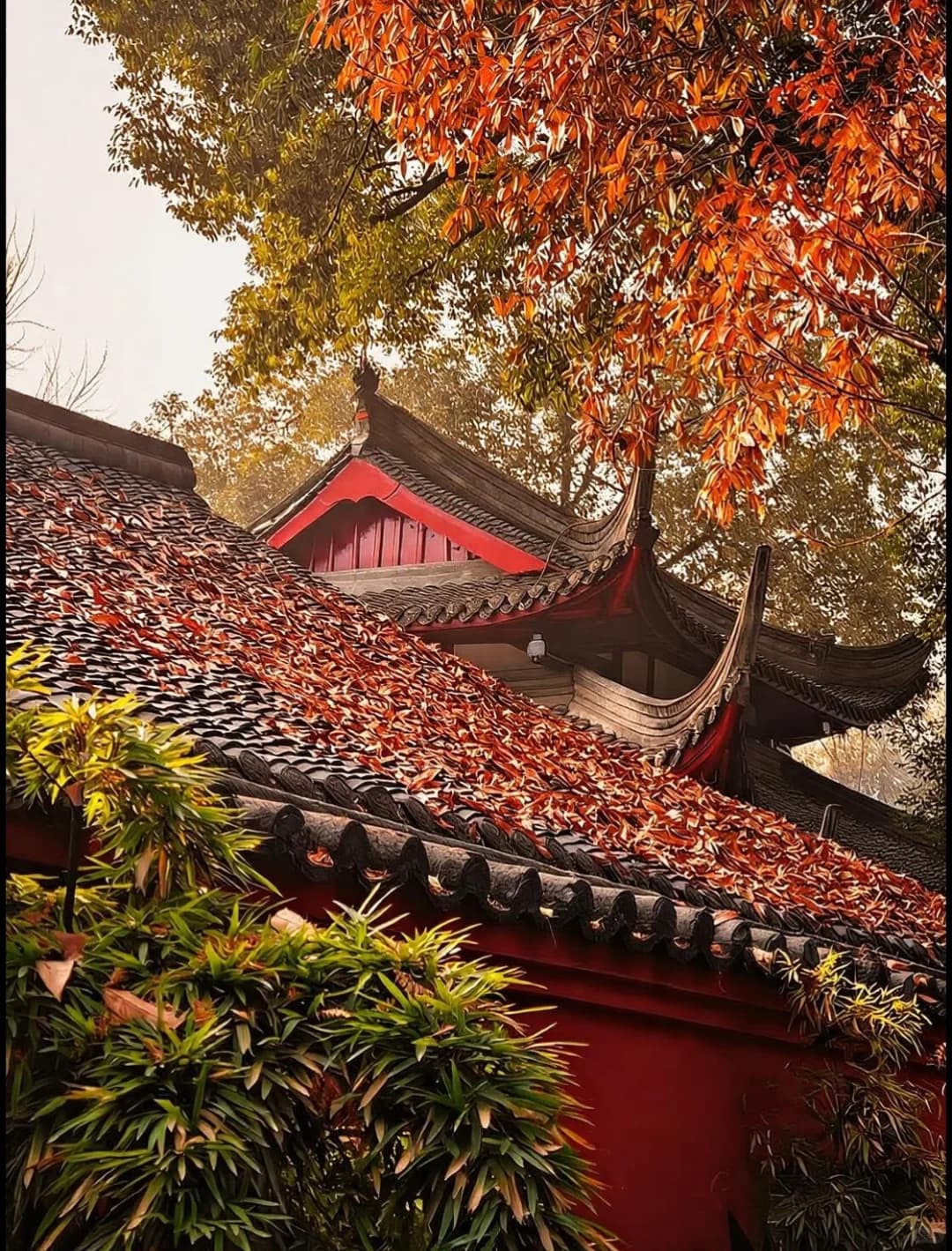
Wenshu Monastery was rebuilt in 1697, and its traditional buildings express the architectural character of the Qing period. Its cultural holdings include Buddhist statues, sutras and other religious objects, giving the complex significance beyond its outward appearance.
Notice how roofs, halls and enclosed spaces shape the experience of moving through a monastery. Read the religious imagery as part of a place of worship, and give people using the site room for their own practice. The architectural details become more meaningful in that context.
Sources & photograph credits
Background and reading notes adapted from the sources below. Photographs are credited to their original authors.
- Chengdu visitor guide: Wenshu Monastery
GoChengdu · Checked
The Wenshu Monastery entry identifies Qingyang District, reconstruction in 1697, Qing architecture, Buddhist sculpture, sutras and other cultural holdings. Observations about how to read the setting are editorial.
Chengdu · Animals, bamboo & habitat
Giant panda conservation
Look beyond the panda’s familiar face to the forests and conservation work that support the species.

Caption & source
From watching an animal to understanding a habitat
A panda encounter can begin a larger story about Sichuan’s mountain forests. Bamboo supplies food, but conservation also depends on a functioning forest, suitable shelter and connections between habitats so that isolated populations are not cut off from one another.
While observing pandas, pay attention to how they handle food, rest and use their surroundings. These are starting points for questions about animal care and wild habitat. The animal in front of you is one part of a much larger ecological story.
Sources & photograph credits
Background and reading notes adapted from the sources below. Photographs are credited to their original authors.
- 大熊猫国家公园:林海筑梦护国宝 协同共治启新程
National Forestry and Grassland Administration · Checked
Supports the importance of forest habitats, bamboo, connected ecological corridors and wider biodiversity. This is general conservation background and does not identify an unnamed visitor base.
Chengdu · A conservation institution
Dujiangyan Panda Base
The Dujiangyan base belongs to the China Conservation and Research Center for the Giant Panda, a distinct conservation organisation.

Caption & source
Read the institution behind the pandas
The China Conservation and Research Center for the Giant Panda lists Dujiangyan alongside its Wolong Shenshuping, Wolong Hetaoping and Ya’an bases. Its remit includes panda research and care, disease prevention, rescue, habitat work and public education.
That institutional background gives the visit a useful focus: how a conservation centre supports the health and future of a species. Read interpretation about animal care alongside what you can observe, and keep the work of this centre distinct from Chengdu’s separate panda breeding research institution.
Sources & photograph credits
Background and reading notes adapted from the sources below. Photographs are credited to their original authors.
- 中心简介
China Conservation and Research Center for the Giant Panda · Checked
Identifies the Center’s Dujiangyan base as one of its four bases and its work in panda research, husbandry, disease prevention, rescue, habitat conservation and public education. It does not establish particular visitor activities or animal sightings.
Chengdu · Poetry among gardens
Du Fu Thatched Cottage
A garden, a memorial and a place to read: Du Fu Thatched Cottage gives Chengdu's literary history a setting of tiled halls, leafy paths and modest domestic scale.
Caption & source
A poet's Chengdu refuge
The Tang poet Du Fu settled beside Huanhua Stream after reaching Chengdu in 759. More than 240 surviving poems belong to his years here. The museum preserves that literary memory within a site repeatedly repaired and expanded over later centuries.
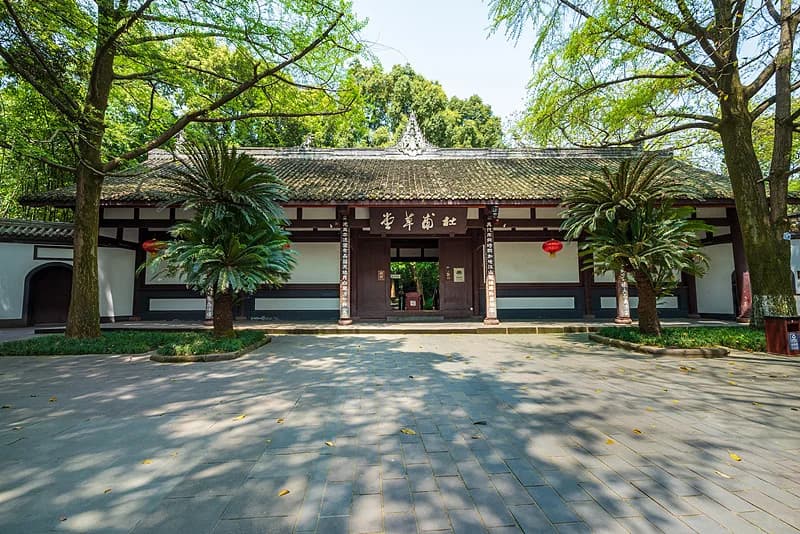
That history adds meaning to the restrained buildings. Look at the depth of the roof eaves, the timber frames and the progression from one courtyard to the next; this is a memorial landscape shaped by generations of readers.
Read the garden slowly
The collected notes draw attention to the bamboo, garden greenery and traditional buildings. Their appeal is in the smaller views: leaves against a wall, a doorway framing another court, and the shade beneath a tiled roof.
A little poetry gives the walk a focus. Read a short account of Du Fu's Chengdu years, then allow time for the garden between the halls. The combination suits an interest in literature, architecture and an unhurried look at detail.
Sources & photograph credits
Background and reading notes adapted from the sources below. Photographs are credited to their original authors.
- 草堂简介
Chengdu Du Fu Thatched Cottage Museum · Checked
Du Fu's arrival, residence, surviving poems, repeated rebuilding, timber buildings and garden collections.
- 成都 3-5 天慢游攻略(悠闲巴适版)
小羊的城市笔记 / Xiaohongshu · Checked
Collected body describes the literary association and garden setting; its original photograph shows the signed museum entrance.
- 成都旅游攻略
海风日记 / Xiaohongshu · Checked
Collected body identifies bamboo, traditional buildings and the appeal of a slow garden walk; prices and schedules are not reused.
Chengdu · Courtyards of the Three Kingdoms
Wuhou Shrine
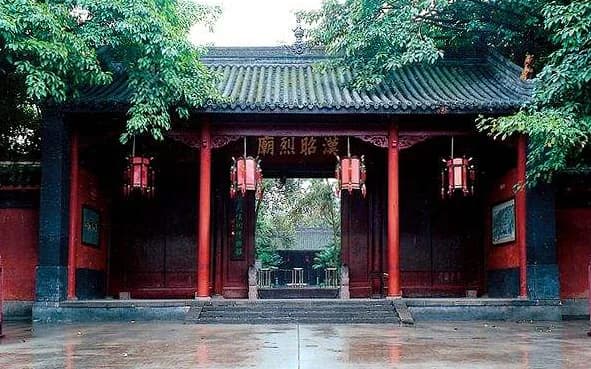
Red columns, dark roof tiles and layered courtyards give Wuhou Shrine a strong visual character. Its deeper subject is the memory of Liu Bei, Zhuge Liang and the Shu Han world.
Caption & source
A ruler and his minister
The shrine commemorates Liu Bei, Zhuge Liang and other Shu Han figures. Its historical precinct brings together Huiling (Liu Bei's tomb), the Han Zhaolie Temple and shrines associated with the same period.
The museum explains how the separate memorials evolved into a shared place of commemoration. Knowing those names makes the sequence of halls easier to follow: the buildings express a relationship between a ruler, his adviser and the ideals attached to them.
Walls, bamboo and changing frames
The collected notes highlight the red walls and bamboo shadows. Along with the tiled eaves and red timber of the entrance, these give the visit an architectural rhythm: enclosed passages open into courts, then draw the eye towards another doorway.
Take the wall photographs as one part of the visit. Pause for the names and stories inside the halls as well, so the colours and courtyards become a setting for history rather than a sequence of backdrops.
Sources & photograph credits
Background and reading notes adapted from the sources below. Photographs are credited to their original authors.
- 武侯祠简介
Chengdu Wuhou Shrine Museum · Checked
Shu Han figures, the Huiling/Han Zhaolie/Wuhou precinct and the development of joint commemoration.
- 成都 3-5 天慢游攻略(悠闲巴适版)
小羊的城市笔记 / Xiaohongshu · Checked
Collected body describes the red walls, bamboo and Three Kingdoms association; original image carries the Han Zhaolie Temple plaque.
- 成都旅游攻略
海风日记 / Xiaohongshu · Checked
Collected body specifically notes red walls, bamboo shadows and Three Kingdoms culture.