
On this page
Our recommendation.
Six calendar days is our more forgiving starting point for this two-city journey. Five can work with suitable arrival and departure times, a focused wish list and one fewer Chengdu city day. The additional day buys flexibility; it does not need to buy another distant excursion.
When this advice applies.
- Both examples start in Chengdu and finish in Chongqing, with arrival and departure counted as trip days.
- The examples focus on city visits and exclude additional regional excursions.
- Transport, tickets, accommodation and specific activity arrangements must be confirmed for your dates.

Count arrival and departure consistently
Five days and six days can describe very different amounts of sightseeing. In these examples, day one includes arriving in Chengdu and the final day includes departing Chongqing. We assume neither is a full sightseeing day. We also protect a block for the intercity move. This gives the comparison a consistent starting point without inventing flight or train times.
Early arrivals and late departures may leave more usable time; the reverse leaves less. Compare those details before choosing an extra hotel night. Keep sightseeing on travel days optional until the transport is settled.
What the extra day changes
This allocation matches our current reference journey. You could instead place the extra night in Chongqing if that city leads your wish list. The split follows your priorities.
Scroll to compare all columns.
| Planning choice | Five-day example | Six-day example |
|---|---|---|
| Chengdu before the move | Arrival day and one full city day. | Arrival day and two full city days. |
| The transfer | Day three, with a modest arrival plan. | Day four, with a modest arrival plan. |
| Chongqing after the move | One full city day, then departure. | One full city day, then departure. |
| What you gain | A focused introduction with fewer fixed activities. | A separate Chengdu day for tea, food or cultural interests. |
| What still needs checking | Arrival times, station pair, access and activity availability. | The same checks; an extra day does not settle the logistics. |
Plan the whole transfer, not just the train
Train running time is only one part of a hotel-to-hotel move. The planning sequence also includes checking out, getting to the departure station, entering and boarding, leaving the arrival station, travelling to the next hotel and settling in. China Railway’s FAQ explains that passengers and belongings undergo security checks, that queues may occur, and that time should be allowed for boarding.
We therefore keep the transfer day’s sightseeing light. No fixed door-to-door estimate or specific service has been verified for this example. Select the train and station pair for your dates, then calculate the two local transfers and a practical station buffer. A shorter train journey is not automatically the best overall connection for your accommodation.
Sources for this section: [1] China Railway 12306.
A focused five-day example
Choose this version when both cities are important, your travel window is fixed and you are comfortable leaving experiences for another visit. The main trade-off is one full day in Chengdu. If pandas are your priority, protect that outing and make the tea or neighbourhood activity optional rather than promising a full second programme.
| Day | Suggested focus |
|---|---|
| 1 · Chengdu | Arrive, settle in and choose a nearby meal. |
| 2 · Chengdu | One main outing, such as a panda visit; an optional city stop if energy allows. |
| 3 · Move to Chongqing | Hotel-to-hotel transfer, rest and an optional short riverside outing. |
| 4 · Chongqing | A focused city circuit, a shared meal and room for an evening view. |
| 5 · Chongqing | Departure, with free time only if the onward schedule allows it. |
A more forgiving six-day example
This version separates Chengdu’s main outing from a slower city day. We prefer it as a starting point when you want time for conversations, a long meal or a change of plan. The Panda Base describes its conservation and visitor-education role; GoChengdu identifies Heming Teahouse in People’s Park. These support the two suggested interests, rather than a guaranteed activity sequence.
| Day | Suggested focus |
|---|---|
| 1 · Chengdu | Arrival and a gentle introduction, depending on timing. |
| 2 · Chengdu | A panda visit or another main interest, with a modest afternoon plan. |
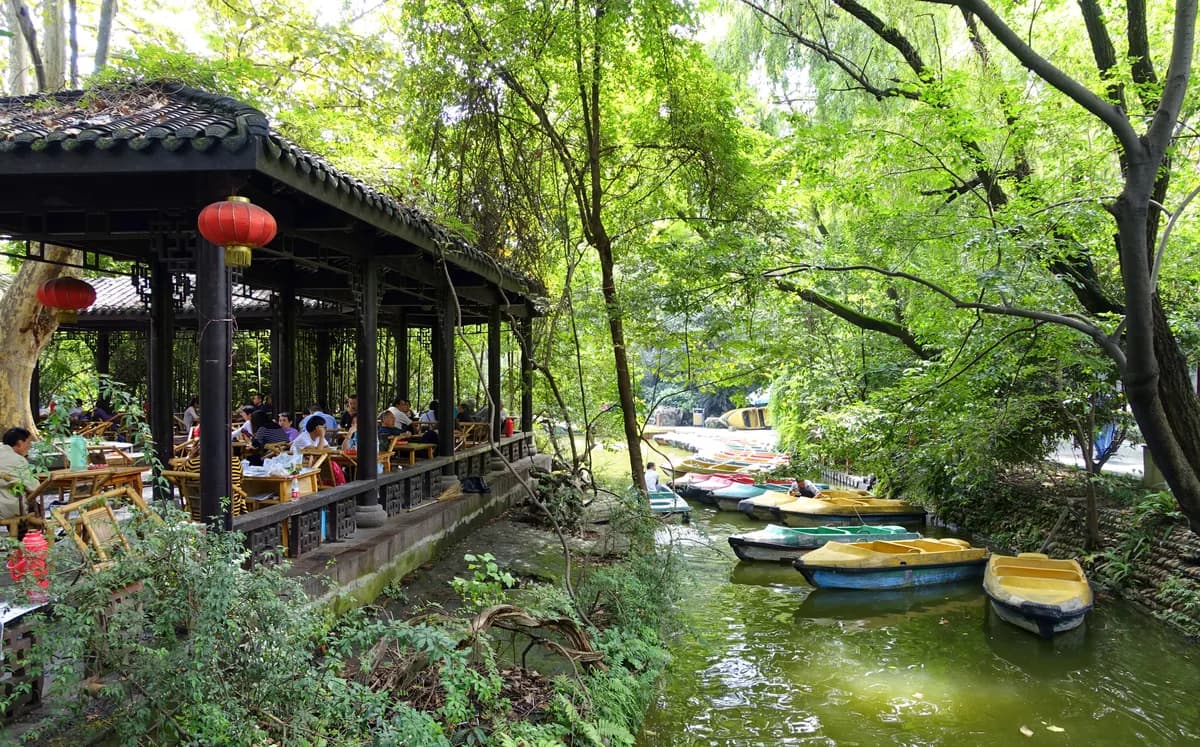
| 3 · Chengdu | Tea, a neighbourhood walk and food or culture shaped around your interests. |
| 4 · Move to Chongqing | Intercity connection, time to settle and an optional riverside walk. |
| 5 · Chongqing | Layered streets and local food, with an evening left available. |
| 6 · Chongqing | Free time and departure arranged around the onward journey. |
Sources for this section: [2] Chengdu Research Base of Giant Panda Breeding; [3] GoChengdu · City of Chengdu.
Use the extra day to protect the pace
Decide whether the extra day is for a specific interest or a less compressed schedule. Immediately filling it with a distant excursion will change the pace.
Chongqing’s official geography overview describes hills and rivers around the urban core. Our planning inference is to check walking routes individually and avoid grouping stops solely by distance on a flat map. For children, older travellers or anyone wanting fewer steps, use the additional flexibility for breaks and suitable transport rather than extending every walking circuit.
Sources for this section: [4] Chongqing Municipal People’s Government.
When one city is the better choice
If packing and moving would take time away from the experiences you most want, five days in one city is a valid alternative. It can also be preferable when your group needs regular rest or the available arrival and departure times leave little room. Choosing one city does not require filling every day: a free afternoon can be part of a deliberate plan.
Check these details before finalising
These allocations are editorial examples developed from public-source research, not measured travel times or a field-tested schedule. Our six-day Chengdu & Chongqing journey is a reference you can personalise. The final proposal should specify the actual sequence and services for your dates.
- Arrival and departure times, plus the locations of your accommodation.
- The dated train service and station pair, followed by both local transfers.
- Availability and current booking arrangements for the chosen activities.
- Walking needs, dietary requirements and how much free time your group wants.
Sources & checks.
Public sources support the facts identified below. Route choices and travel-pace recommendations are Matchstick China’s editorial judgement.
- China Railway English FAQ
China Railway 12306 · Checked
The FAQ identifies 12306 as the official railway service and explains station security, possible queues and the need to allow boarding time. It does not substantiate any Chengdu–Chongqing timetable, fare or door-to-door duration in this note.
- Brief Introduction
Chengdu Research Base of Giant Panda Breeding · Checked
The Chengdu Panda Base is a conservation, research, breeding and visitor-education institution. This source does not establish the availability of a particular visit, animal sighting or booking arrangement.
- Teahouse Leisure for Chengdu’s Autumn
GoChengdu · City of Chengdu · Checked
The city publication identifies Heming Teahouse in People’s Park and describes tea as a local leisure activity. We do not reproduce its opening hours or infer guaranteed availability.
- Geography
Chongqing Municipal People’s Government · Checked
The government overview describes Chongqing’s mountainous terrain and the central urban area around the Yangtze and Jialing rivers. Specific walking difficulty and access must be checked for the chosen route.
Find the pace that suits you.
Tell us your dates, interests and who’s travelling. Start your planning draft with the cities in this note.
Plan my tripThis preview creates a draft for you to review and download.